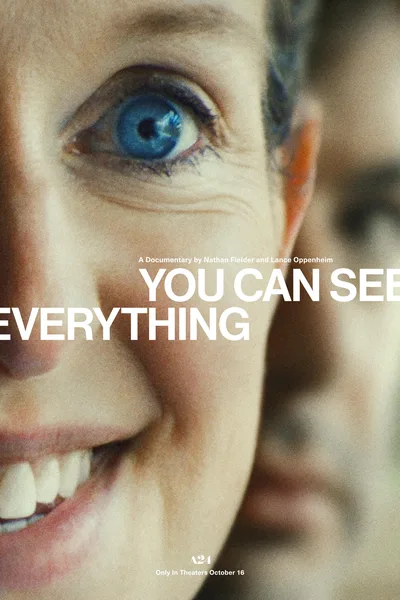
You Can See Everything
★★★★Worth watchingIs You Can See Everything worth watching? (No spoilers)
I finally get why documentaries can win best picture. Nothing really happens, yet it's never boring. Elizabeth Holmes and everyone around her are fascinating, and Nathan Fielder's pointblank questions and awkward silences are hilarious. It leaves you without a final verdict, and that's the point. Absolutely worth watching.
⚠️ Spoiler warning: everything below the quick take, including the full review and ending explained, contains spoilers.
You Can See Everything review
I now understand why documentaries can win best picture.
Not a single moment of this movie feels boring, which is amazing considering nothing at all happens.
It is an amazing piece on Elizabeth Holmes post the crime. I'm amazed just how fucking insane everyone seems to be in her life. Her ironclad shell of being innocent regardless of the literal fact that her product does not work is dread inducing.
Nathan Fielder is hilarious, and amazing to watch. However I did feel by inserting himself as a character in their lives, instead of a pure documenter, he shifts the final product further from documentary and closer to movie territory. Nonetheless, his pointblank questions, uncomfortable silence, and stares from behind corners is quite iconic and enjoyable to watch.
The film does a great job of leaving you wanting more, upset there is no final verdict. This is hard to sit with, but is far more truthful the a wall of text telling us what to sheepishly believe.
Amanda was a great inclusion, although the later reenactments felt unnecessary and added to the movie like nature of the documentary. Her role was interesting, and so was the way they used her. She was essentially a vessel for us to hear both Nathan's internal thoughts, and an outsiders thoughts. She also allowed them to present unrecorded moments as facts, which was as problematic as it seems.
The truth is there just isn't any way to know for sure. Is Elizabeth truly an innocent, albeit naively stupid, woman taken advantage of by man after man. Or is she extremely manipulative and sinister, using everyone around her as cannon fodder.
The answer is probably somewhere in between, but without knowing her true thoughts, we'll never know for sure.
You Can See Everything ending explained
While the film initially follows Theranos founder Elizabeth Holmes in the 34 days before she reports to prison for fraud, it ends up continuing on for three more years. Near the end, frustrated that Holmes's partner Billy Evans is blocking access to her, Nathan Fielder secretly visits Holmes in prison. She says she trusts Evans completely, including letting him run her social media and an AI model of her. Up until this point it had started to look like she was being controlled and lied to by Billy, and was unaware of what he was doing with her name. However this seemed to support that she did in fact understand and wanted it.
Amanda Seyfried, who plays Holmes in the reenactments, tells Fielder 'You care about her,' and he has no answer. That raises the question of whether the filmmakers lost their objectivity, or got played. Did Fielder let his emotions get in the way of showing us who Holmes really is? Unfortunately it remains one of many mysteries.
The film ends without a verdict. It never comes out and tells you whether Holmes is a manipulator, a victim, or a sincere person who's just deeply naive. That's the point: there's no way to know what's really going on in her head.
My take: it's hard to sit with, but it's far more honest than a wall of text telling you what to believe.
Does You Can See Everything have a post-credits scene?
No. You Can See Everything has no mid-credits or post-credits scene.
Movies like You Can See Everything
- The Inventor: Out for Blood in Silicon Valley (2019) – the documentary on the rise and fall of Theranos
- The Jinx (2015) – a filmmaker getting uncomfortably close to his subject
- Exit Through the Gift Shop (2010) – a documentary where you're never sure what's real
- Primetime (2026) ★★ – also from director Lance Oppenheim