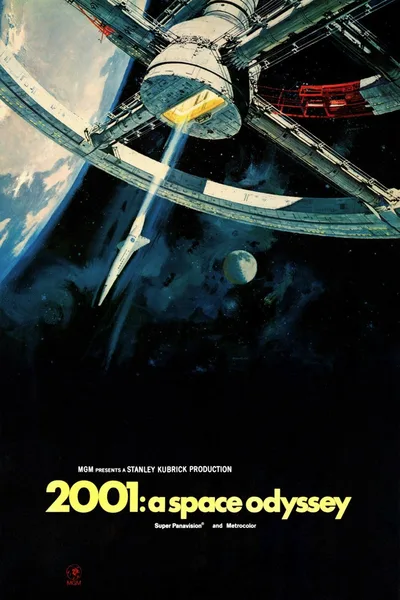
2001: A Space Odyssey
★Skip itIs 2001: A Space Odyssey worth watching? (No spoilers)
Gorgeous, iconic, and never as slow as its reputation says. The middle stretch with HAL is genuinely great. But the last act trades story for long, empty visuals, and without the book to explain it, the film doesn't say much on its own. Watch it for the history and the score, not because it's a masterpiece.
⚠️ Spoiler warning: everything below the quick take, including the full review and ending explained, contains spoilers.
2001: A Space Odyssey review
At no point did this film ever feel too slow, which was shocking to me.
Sure the start takes its time, and we don't really start the story for a good 45 minutes, buts its engaging enough that it doesn't really matter.
The middle of the film is by far the strongest, the slow artsy shots start having something to say, the monolith and mission is intriguing, and HAL is a terrifying villain.
Aaaaaaaand then it all goes to shit.
The artsy fartsy shots get longer and longer, with less and less meaning or purpose. And the ending is nothing short of inexplicable nothingness.
Look I love films you need to rewatch and breakdown, LOVE them.
But no one I've met or read about has been able to explain anything without first saying "well in the book" which is so ridiculous.
The film needs to say something on its own. Without some book explaining the ending you realize the movie is mostly just an artsy version of a slasher film. Like this is the cinephiles batman forever.
Also the idea that, oh its godlike aliens that put him in a zoo, then send him to earth with god like powers is nowhere near as brilliant as everyone wants you to believe it is.
Look the shots are gorgeous (although the match cut is ridiculously overrated), the effects still hold up, and the score is beyond iconic. But with no real substance outside of culturally iconic moments, I feel the initial audiences and critics were right, this kinda sucks.
2001: A Space Odyssey ending explained
After HAL is shut down, Dave Bowman takes a pod out to a giant black monolith orbiting Jupiter. He's pulled into the famous 'Star Gate' sequence: a long, psychedelic ride through light and color that represents him passing beyond normal space and time.
He ends up in a strange, elegant hotel-style room. Over a few minutes he sees older and older versions of himself, until he's an old man dying in bed. A monolith appears at the foot of the bed, and Bowman is transformed into the 'Star Child,' a glowing fetus in a bubble that floats back toward Earth.
The usual reading (backed up by Arthur C. Clarke's novel) is that the alien intelligence behind the monoliths has been guiding human evolution. The first monolith pushed apes to use tools; the last one pushes humanity to its next stage. The room is a kind of zoo or holding space the aliens built from Bowman's own ideas of comfort.
My take: the film needs the book to make that clear, and on screen alone it mostly feels like an artsy, drawn-out finale.
Does 2001: A Space Odyssey have a post-credits scene?
No. 2001: A Space Odyssey has no mid-credits or post-credits scene. The film actually opens and closes with music over a dark screen (an overture and exit music), so there's nothing to wait for once the credits roll.
Movies like 2001: A Space Odyssey
- Interstellar (2014) – big, philosophical space travel with a mind-bending final act
- Solaris (1972) – slow, meditative sci-fi about contact with something unknowable
- Annihilation (2018) ★ – an alien force that rewrites people, with an ending built for debate
- Arrival (2016) – aliens, language and time, but with a much clearer payoff